
The Dwarf Planet
Pluto was once considered the ninth planet in our solar system but in 2006 it was declared a dwarf planet instead. Pluto is 39 AU (astronomical units) away from the sun with a year lasting 248.89 Earth years long. Pluto gets its name from the Roman god of the underworld and has five moons.

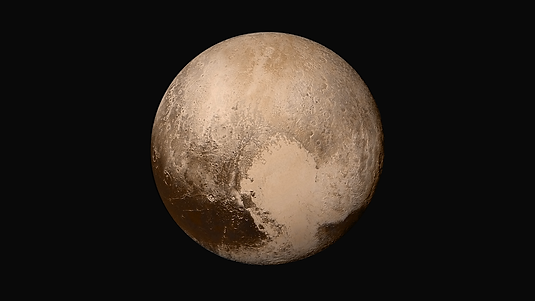



Pluto Facts
-
Pluto is smaller than Earth's moon and is about half the width of the United States
-
Pluto's orbit is oval and tilted meaning that at some points it is closer to the sun than Neptune
-
Pluto's 248-year-long, oval-shaped orbit can take it as far as 49.3 astronomical units (AU) from the sun, and as close as 30 AU.
-
-
Pluto's orbit takes place in a region called the Kuiper Belt
-
A day on Pluto is about 153 hours which is six Earth days
-
Pluto's largest moon is Charon
-
Charon is so big that Pluto and Charon actually orbit each other like a double planet
-
-
The only spacecraft to reach Pluto was NASA's New Horizons telescope in 2015
-
Pluto's surface is too cold to support life with temperatures ranging from -378 to -396 degrees F
-
Pluto has a very thin atmosphere made up of nitrogen, methane and carbon monoxide
-
The atmosphere has a blue tint and a distinct haze
-
-
Pluto has a heart shaped glacier that is bigger than Texas
-
Pluto is so far away that if you were to stand on the surface of Pluto at noon, the sun would be 1/900 the brightness it is here on Earth, or about 300 times as bright as our full moon.