
The Last Planet
Neptune is the eighth and most distant planet from the sun at 30.1 AU (astronomical units) away from the sun. Neptune gets its name from the Roman god of the sea. Out of the four outer planets, Neptune has the least amount of moons with 14. Neptune also has the longest year at 164.81 Earth years.


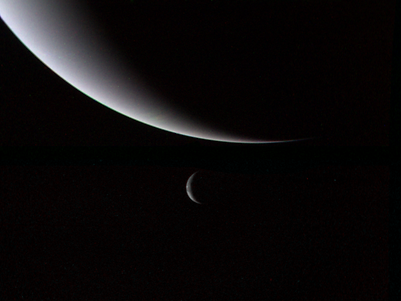
Neptune Facts
-
Neptune is the only planet in the solar system that is not visible with the naked eye
-
A day on Neptune lasts about 17 hours and a year is 165 Earth years
-
Just like Uranus, Neptune is an ice giant
-
Most of its mass is a hot, dense fluid of "icy" materials (water, methane and ammonia) above a small rocky core.
-
-
Also like Uranus, Neptune is about 4 times as wide as Earth
-
Neptune's 14 moons are named after sea gods and nymphs in Greek mythology
-
The largest of these moons is Triton
-
-
Neptune has very faint rings, at least five main rings and four more ring arcs
-
Voyager 2 is the only spacecraft to fly by Neptune as it was on its way out of our solar system
-
Neptune can not support life as we know it
-
Neptune's atmosphere is similar to Uranus as it is composed of mostly molecular hydrogen and atomic helium with a bit of methane
-
Neptune has supersonic winds that cover the planet
-
Neptune was the first planet located through mathematical calculations