
The First Planet
Mercury is the closest planet to the sun at .4 AU (Astronomical Units), and is also the smallest planet in our solar system. Mercury is only slightly larger than our moon. Mercury is named after the Roman god of speed as its orbit is only 88 Earth days.


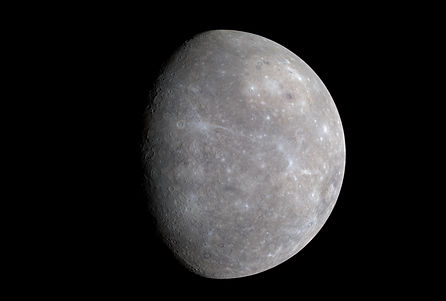
Mercury Facts
-
A day on Mercury is 59 Earth days, while a day-night cycle takes 175.97 Earth days
-
Mercury is so close to the Sun, day temperatures can reach highs of 800°F (430°C) and at night due to the lack of atmosphere to retain the heat, temperatures can dip as low as -290°F (-180°C).
-
Mercury does not have an atmosphere but instead has an exosphere made up of atoms blasted off the surface by the solar wind and striking meteoroids.
-
The sun would appear three times larger than it does on Earth if you were to be on Mercury
-
Mercury has an elliptical (egg shaped) orbit
-
Mercury is a little more than 1/3 the width of Earth with a radius of 1,516 miles (2,440 kilometers).
-
It takes sunlight 3.2 minutes to reach Mercury
-
Mercury has the fastest orbit of all the planets at 88 days meaning it travels at 29 miles per second around the sun
-
Mercury is the second densest planet after Earth and has a large metallic core
-
Along with Venus, Earth, and Mars, Mercury has a rocky surface filled with craters like our moon.
-
The surface is littered with craters from meteoroids and comets
-
Craters and features on Mercury are named after famous deceased artists, musicians or authors, including children's author Dr. Seuss and dance pioneer Alvin Ailey.
-